
Table of contents
Volume: 2
Issue: 1
1. On the History and Etymology of the Humerus
A historical and etymological review of the bone of the arm, the humerus, is presented, as recognized in the current international Terminologia Anatomica. This bone element was adopted into Latin later in history, since it was initially designated in Greek to refer to various components of the upper limb, encompassing structures from the hand to the elements of the shoulder girdle.
2. Complete Bilateral Muscle Replacement with Adipose: A Histological Analysis
Skeletal muscle fat infiltration (myosteatosis) is an ectopic fat depot that increases with age and negatively impacts cardiovascular, metabolic, and musculoskeletal health. This fat infiltration is typically distributed throughout the body. In rare instances, a muscle is completely replaced by adipose tissue. During a gross anatomy class, a cadaver was discovered to seemingly have a complete bi-lateral replacement of full-size gastrocnemius muscles with adipose tissue. A histological analysis using H&E and Gomori staining was used to examine the gastrocnemius muscles in proximal and distal locations. A 63-yr old female cadaver presented a very robust musculature, except for bilateral gastrocnemius color, with no obvious anatomical pathologies. Upon gross visualization, the gastrocnemius medial heads (bilateral) appeared completely replaced with adipose tissue. Histologically, no nerve or vascular pathologies were identified as a likely cause. In the muscle, the transition to adipose appeared to occur progressively and was nearly complete (with some inflammation and fibrosis) in the medial head. The pathology appeared to originate distally (Achilles tendon) in the medial head, progressing from distal to proximal. Histology revealed the pathology progressing similarly in the lateral head, progressing from healthy muscle cells, to inflammatory cells, to connective tissue to fat. Notably the pathology was symmetrical between the right and left leg. To our knowledge this is the first report of near complete replacement of muscle with adipose tissue occurring symmetrically, in both legs and heads of the gastrocnemius muscle. Awareness of this pathology could assist clinicians working with patients who have trouble walking seemingly related to lower leg strength and scientists studying muscle loss
3. Social Neurocognition and the Cerebellum: Correlations Between Reading the Mind in the Eyes Test Scores and Cerebellar Morphometry in Patients with Behavioral Variant Frontotemporal Dementia
Behavioral variant frontotemporal dementia (bvFTD) poses significant challenges for early diagnosis and is characterized by early impairments in social cognition. Recent evidence suggests the involvement of extracortical structures, particularly the cerebellum, in its pathophysiology. In this context, the present study aimed to analyze the correlation between performance on social cognition tasks and cerebellar morphometry in patients with bvFTD, considering its clinical and forensic relevance. Forty-nine patients with bvFTD were evaluated using the Reading the Mind in the Eyes Test and the Faux Pas Test. Clinical severity was assessed with the Clinical Dementia Rating (CDR), Global Deterioration Scale (GDS), and Frontotemporal Dementia Rating Scale (FTD-FRS). Structural brain MRI (1.5 T) was performed, including morphometric analysis of the cerebellar vermis and subsequent correlational analyses. A high prevalence of social cognition impairments was observed from the early stages of the disease. The Faux Pas Test demonstrated greater clinical sensitivity. Performance on the Reading the Mind in the Eyes Test showed a strong correlation with volumetric reduction of the posteroinferior cerebellar vermis (r = 0.89; p < 0.01). These findings support the role of the cerebellum, particularly the vermis, in social neurocognition in bvFTD and highlight its potential as an early structural biomarker.
4. Arterioportal Fistulas: Literature Review and Case Report Identified in a Uruguayan Specimen
Arterioportal fistulas are defined as abnormal communications between the portal vein and one or more systemic arteries. They are classified as intrahepatic or extrahepatic and may be either congenital or acquired. Although they are relatively uncommon, their clinical relevance is significant. These fistulas may present with portal hypertension, gastrointestinal bleeding, hemobilia, liver failure, or heart failure; however, they can also remain asymptomatic. A literature review was conducted using databases such as Google Scholar and PubMed, among others, employing both MeSH and non-MeSH terms. The reported case was identified during a routine anatomical dissection of a female cadaver. The literature review identified the most frequent etiologies, the arteries most commonly associated with this type of fistula, their clinical implications, and the main therapeutic approaches. During cadaveric dissection, a vessel was observed connecting the supraduodenal artery to the portal vein, consistent with an arterioportal fistula. Despite their low prevalence, arterioportal fistulas are important to recognize due to their potential clinical consequences. This study also underscores the relevance of detailed anatomical knowledge for accurate diagnosis and appropriate surgical management.
5. Innovation in Biological Preservation at Universidad de Guayaquil: Scientific Evidence of Glycerinization
Fixation is a well-established principle used in forensic medicine, histology, pathology, and immunohistochemistry; meanwhile, preservation in anatomy involves maintaining the biological sample in good condition. In the preservation laboratory of the Faculty of Medical Sciences at the University of Guayaquil, known as the Anatomical Preparations Workshop, Glycerinization by vascular repletion has been implemented for the preservation of real models intended for the teaching of Morphological Sciences. This technique has been periodically improved and refined by applying a tolerable compound without affecting the health of students, teachers, visitors, or the environment. Glycerinization ensures good fixation results and better preservation with optimal outcomes, especially due to the flexibility of the specimens and their multiple applications in the Health Sciences, particularly in the field of research. Glycerinization is the accepted technique at our University; its components have been standardized and adapted to environmental conditions with good results. Glycerinization was sustained during pandemic times; therefore, it is a biologically proven technique in the academic field.
6. Insights into "Anatomy of the Temporomandibular Joint" by Dr. Ramón Fuentes and Dr. Nicolás Ottone
The book "Anatomía de la articulación temporomandibular" by Ramón Fuentes and Nicolás Ottone offers a focused and didactic review of temporomandibular joint (TMJ) anatomy that is especially valuable for students, clinicians, teachers and morphology researchers. Its major strength lies in the integration of classical anatomical description with contemporary terminology, functional interpretation, and clinically oriented discussion. Across its chapters, the text examines the mandibular condyle, mandibular fossa and articular eminence, articular disc, capsule, ligaments, vascularization, innervation, and selected concepts linked to centric relation and clinical examination. Particularly noteworthy is the authors’ emphasis on fibrocartilaginous functional surfaces, the layered organization of the articular disc and retrodiscal tissues, the debated status of some ligamentous structures, and the neurovascular relationships that support both function and pain generation. The work also succeeds in framing anatomy as the basis for understanding joint biomechanics, diagnostic reasoning, and temporomandibular disorders. It is a concise anatomical synthesis that connects structure, terminology, and clinical meaning. For readers interested in the craniofacial complex, the book constitutes a timely and useful contribution to the anatomical literature on the TMJ.
7. Morphological and Structural Analysis of the Bifid Mandibular Condyle Using Cone Beam Computed Tomography. A Case Report
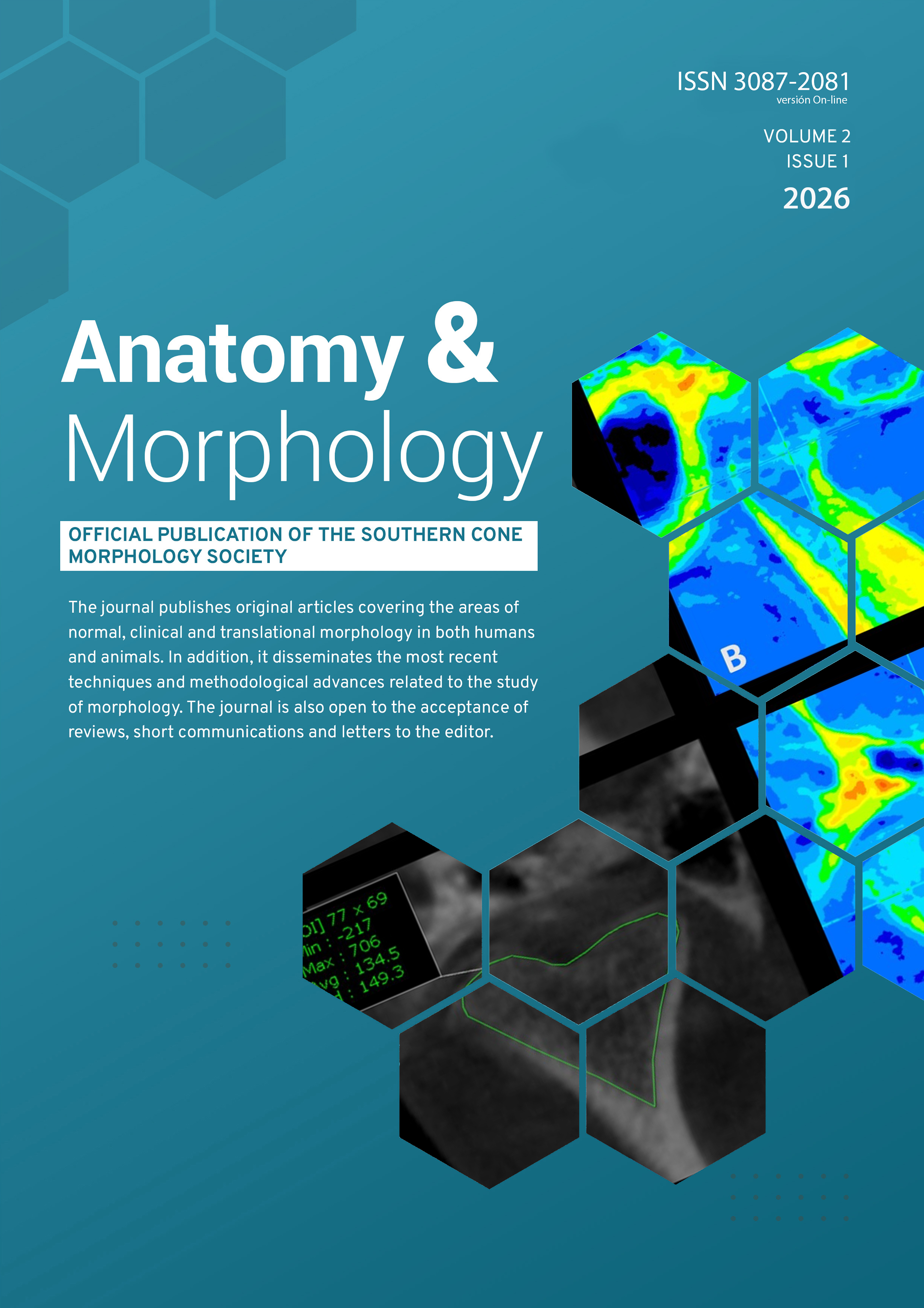
The bifid mandibular condyle is an uncommon morphological anomaly characterized by division of the condylar head into two articular surfaces. Commonly considered a radiological finding, its etiology may be congenital, traumatic, genetic, or environmental. Its orientation is usually classified as mediolateral or anteroposterior. BMC is generally asymptomatic, although it may also present with arthralgia, joint sounds, and functional limitation of the temporomandibular joint (TMJ). In the present case, evaluation by digital orthopantomography (OPT) revealed the initial suspicion of a unilateral right BMC. Cone-beam computed tomography (CBCT) confirmed the diagnosis and enabled a thorough three-dimensional analysis. Using specific TMJ software tools and pseudocolor algorithms, it was possible to determine not only the morphology but also the degree of mineralization of the BMC, detecting low-density trabecular bone (85 HU) and a thin cortical layer with loss of continuity. Although the prevalence of BMC is not well known, in recent years, thanks to high-resolution procedures such as CBCT, its prevalence appears to be higher than previously reported, reaching up to 5.8%. This advanced imaging algorithm is consolidated as the “gold standard” for the diagnosis and analysis of BMC, overcoming the limitations of conventional radiology by providing detailed information in the three spatial planes and 3D reconstructions with low radiation exposure for the patient, following the ALADAIP principle: as low as diagnostically acceptable, indication-oriented, and patient-specific. In conclusion, in some patients with a diagnosis or suspicion of bifid mandibular condyle, clinical and radiological examination should be complemented by specific high-complexity imaging methods that provide high-resolution images, allowing a thorough and complete analysis of each anatomical detail for a more precise assessment of the bifid mandibular condyle.